
Aitkin County Court Records After Arrest
The Aitkin County Attorney describes the local path from law-enforcement contact to a court case. After criminal activity is reported, an officer may issue a citation or submit investigative material to the County Attorney's Office. A prosecutor reviews the material, and if there is enough evidence, a criminal complaint is drafted. When the complaint is issued by the County Attorney's Office and signed by a judge, the defendant is scheduled to appear in court. That filed case is the court record after a jail arrest.
This court record is separate from the custody record. The jail roster can show that a person is currently held at Aitkin County Jail, when they were booked, the holding agency, visible bond totals, and charge lines. The court record tracks the formal case, hearings, filed documents, charge status, and dispositions. For custody details, use Aitkin County jail inmate records. For booking photos, use the Aitkin County jail mugshots page because the court case portal is not a mugshot gallery.
The Aitkin County Attorney's court-process page explains how law enforcement submissions become prosecutor charging decisions.
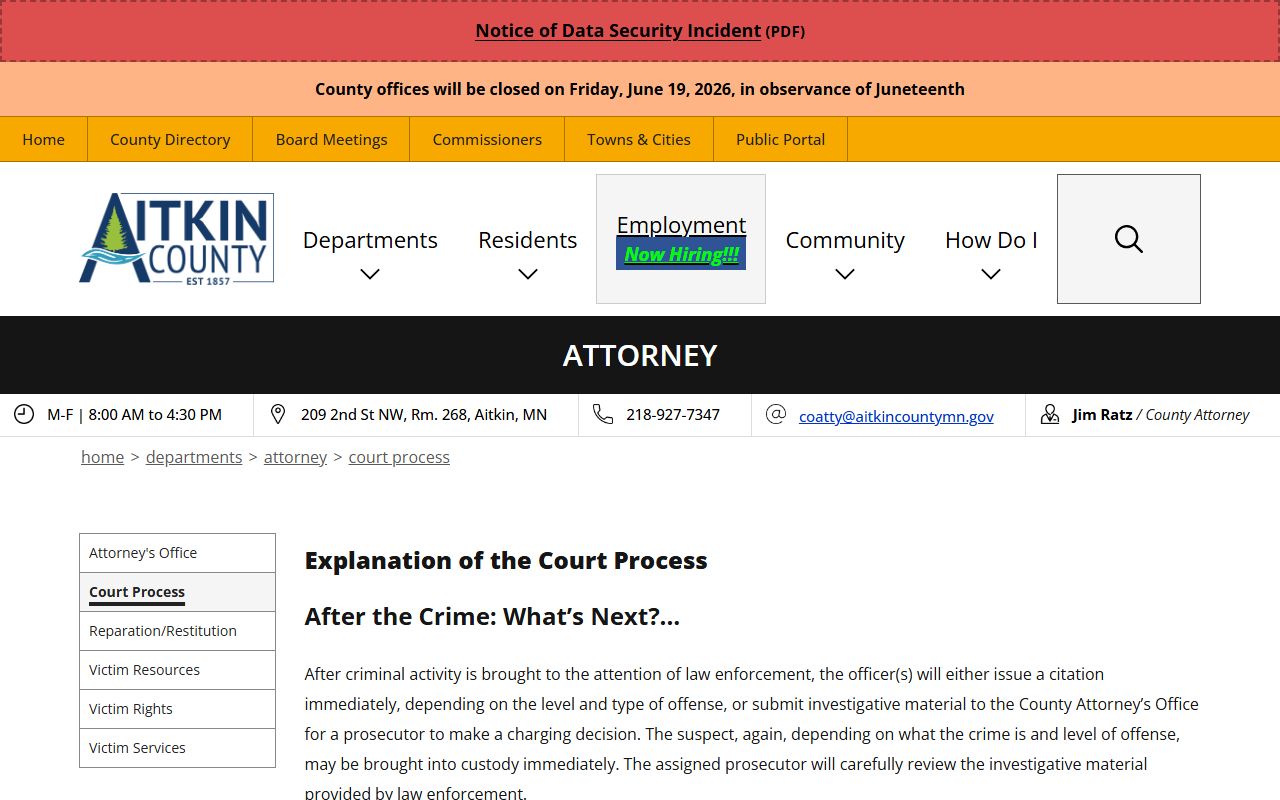
That charging step is why a jail roster charge and a later court charge should be compared rather than treated as the same record.
Search Aitkin Court Records After Arrest
The statewide portal for public district court records is Minnesota Court Records Online, often shortened to MCRO. Aitkin County District Court is part of Minnesota's Ninth Judicial District and handles criminal, traffic, civil, family, probate, and juvenile matters filed in the county. MCRO is free, but it is not the same as a certified court record and it has remote-access limits.
- Start with the Aitkin jail roster if the arrest is recent, and capture the person's name, booked date, agency, and charge statute.
- Check the Aitkin County District Court calendar for near-term hearings if the case is very new.
- Search MCRO by case number when available, because pending criminal cases may not return by defendant name.
- Open the case record and compare the formal charges with the jail roster charge lines.
- Contact Aitkin Court Administration for certified copies or public records not available through remote access.
MCRO warns that pending criminal, traffic, and petty misdemeanor cases without a conviction may not return in name search results, even when a public record exists. A case number, hearing search, courthouse terminal, or direct court administration request may be needed. The Aitkin County District Court page says court calendars are posted at 7:00 a.m. each business day and updated hourly, but hearing schedules can change.
Aitkin Court Records Search Fields
The court search path is stronger when a case number is known. A jail roster rarely gives a court file number, so the first few days after arrest can require several checks. Use the roster, court calendar, and court administration together when the MCRO name search is limited by remote-access rules.
| Field or option | Use | Limit |
|---|---|---|
| Case Search | Public case records for Minnesota district courts. | Remote access is narrower than courthouse access. |
| Name search | Useful for many defendant lookups. | Pending criminal cases without conviction may not return by name. |
| Case number search | Best fallback when a number is known. | Requires the exact or usable case number. |
| Hearing search | Useful for court dates and first appearances. | Calendar entries can change. |
| Certified copies | Official copies for legal use. | Come from court administration, not the portal. |
Charging Records After Jail Arrest
The Aitkin County research specifically documents criminal complaints. Minnesota cases often begin when the prosecutor drafts a complaint and a judge signs it. Other charging terms may appear in broader criminal practice, but the Aitkin County Attorney's local process page points readers to complaint-based charging after law enforcement submits material.
| Document type | Who creates it | What it does |
|---|---|---|
| Complaint | Prosecutor, then judge review/signature | States formal charges and starts many Minnesota criminal cases. |
| Information | Prosecutor | Formal charge document used in some criminal procedures. |
| Indictment | Grand jury | Charging document for certain serious felony matters. |
Booking charges can be rougher and earlier than formal court charges. A jail line may show a statute and short charge phrase tied to the arrest. The complaint may add detail, revise the offense level, or omit a charge after review. That difference is one reason court records after a jail arrest should be checked after the first appearance and prosecutor review.
Aitkin County Charge Status
Court records change as a criminal case moves. A charge can stay pending, be amended, be reduced through plea negotiation, be dismissed, or result in a conviction after a plea or trial. The County Attorney page says misdemeanor defendants often plead guilty at first appearance, while gross misdemeanor and felony cases may have multiple hearings. It also says every case can go to trial, although most are settled by plea agreement.
| Status | What it means |
|---|---|
| Pending | The case is open and the charge has not reached final disposition. |
| Amended | The formal charge was changed after filing. |
| Reduced | The charge level or offense was lowered, often through negotiation or review. |
| Dismissed | The charge was ended by court or prosecutor action without conviction on that count. |
| Convicted | A plea or verdict produced a conviction on that charge. |
Bond After Aitkin County Arrest
The Aitkin roster has a column labeled "Bonds for Unresolved Hold Reasons - Remaining Total." The research found examples of visible bond amounts and blank entries, but the roster does not explain bond type, payment method, cash or surety terms, or whether a listed amount will actually cause release. A probation hold, warrant, domestic assault condition, another-agency hold, DOC hold, federal detainer, or immigration detainer can block release even when money appears in a bond column.
| Release or hold type | How it works |
|---|---|
| Cash bond | Money is paid under the court's order, if the person has no blocking hold. |
| Surety bond | A licensed bail bond agent may post security when allowed by the court. |
| Personal recognizance | The person is released on a promise to appear and follow conditions. |
| Conditional release | Release depends on court-ordered terms such as no contact or monitoring. |
| No-bond hold | Ordinary payment will not release the person until the hold is cleared. |
Call Aitkin County Jail at 218-927-7456 before bringing money or contacting a bonding company. Local bond payment methods and bond-posting hours were not published in the official jail page reviewed.
Aitkin Warrants and Arrest Records
No official Aitkin County active-warrant search database was located in the research. The Sheriff's Administration page says the office receives and processes documents from court, including arrest warrants, and the sheriff contacts page gives records, civil process, dispatch, and main sheriff numbers. MCRO may show public case entries related to warrants or bench warrants when remote access permits, but it should not be treated as a complete warrant list.
- Arrest warrant
- A court order authorizing an arrest in a criminal matter.
- Bench warrant
- A warrant often issued after failure to appear or violation of a court order.
- Probation hold
- A custody reason tied to alleged probation violation, often reflected by Minnesota Statutes section 609.14 language.
- Detainer
- A request from another authority to hold or notify before release.
Charges Versus Convictions
An arrest and charge are not the same as a conviction. The arrest starts custody and investigation. A charge is an accusation filed or pursued through the court process. A conviction occurs only after a guilty plea, guilty verdict, or other conviction-level outcome. The difference matters when reading Aitkin County court records after a jail arrest because a public charge can remain pending, be changed, or be dismissed.
| Question | Charge | Conviction |
|---|---|---|
| Case stage | Accusation after arrest or prosecutor review. | Final or conviction-level court outcome. |
| Proof level | Filed based on legal charging standards. | Results from plea or proof beyond a reasonable doubt. |
| Where found | MCRO, court calendar, complaint, roster clues. | MCRO disposition and BCA public criminal history. |
| Can change | Yes, charges may be added, amended, or dismissed. | May later be appealed, sealed, expunged, or otherwise limited by law. |
Sealed and Expunged Court Records
Minnesota court and criminal-history records can be limited by sealing, expungement, juvenile protections, domestic abuse or harassment order restrictions, child-protection rules, civil commitment rules, and MCRO remote-access limits. The research points to Minnesota Statutes section 13.04 for data-subject rights to inspect public and private data about themselves and challenge inaccurate or incomplete data. The court process, not a mugshot site or unofficial search page, is the proper route for court record limits after an eligible outcome.
| Issue | Sealed | Expunged |
|---|---|---|
| Public visibility | Public access is limited by court order or rule. | Access is sealed or restricted through an expungement process. |
| Where to start | Aitkin County District Court or the issuing court record. | Court filing process and the agencies holding records. |
| Jail roster effect | Does not automatically rewrite every live custody entry. | May require agency handling once an order is entered. |
BCA History and MCRO
Minnesota Bureau of Criminal Apprehension public criminal history search is different from MCRO. MCRO is a court-record portal with case and hearing data, public documents, and remote-access restrictions. BCA criminal history is the conviction-level public criminal-history path and requires the listed name and date-of-birth fields. MCRO itself warns that it should not be used for background checks.
Important: Do not use casual jail, court, or linked search results for employment, tenant, credit, or insurance screening.
Restricted Court Records After Arrest
Some court records after an Aitkin County arrest will not appear online even when a public record exists somewhere in the court system. MCRO restricts online access to some pending criminal and traffic cases without conviction, certain juvenile delinquency matters, domestic abuse and protection-order records, child-protection documents, civil commitment records, party street addresses, and other restricted data. Courthouse terminals and court administration may have a different access level than the public portal.
For certified copies, contact Aitkin County District Court rather than relying on a screenshot or downloaded portal page. The Judicial Branch lists Aitkin County District Court at 209 Second Street NW, Room 242A, Aitkin, MN 56431, with Court Administrator Dana Anderson and business hours Monday through Friday, 8 a.m. to 4:30 p.m.
Public Record Search
Sponsored Results